Our mission: ‘To encourage and improve horticulture in NZ by promoting the understanding, appreciation, conservation and use of plants’.
Plant Doctor Archive
Splotches on flax and cabbage trees

 I
HAVE sent photos of some of my flax bushes and cordylines which
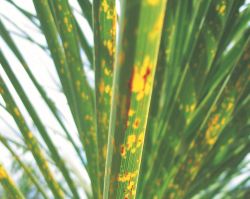
both have ugly marks on them. The cordylines have yellow splotches
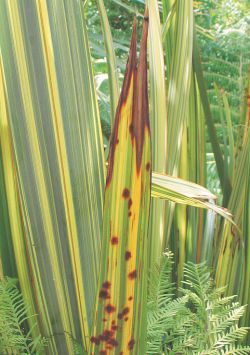
and the flaxes have brown splotches. Is this caused by a bug or a
fungal disease?
I
HAVE sent photos of some of my flax bushes and cordylines which
both have ugly marks on them. The cordylines have yellow splotches
and the flaxes have brown splotches. Is this caused by a bug or a
fungal disease?
 IT LOOKS like you have two
separate problems. Some flax varieties, including variegated ones
like yours, can be susceptible to fungal leaf spot if the
conditions they’re growing in are rather damp and humid. Flaxes
grow best in relatively open, sunny spots with lots of fresh air
blowing around them. So, to reduce the risk of leaf spot, prune
away nearby growth to expose the leaves to as much light as
possible and allow whatever breeze there is to blow around the
plant and dry out the foliage. It’s also a good idea to cut out
badly spotted leaves close to the base, along with any dead
leaves, to reduce the risk of infection. You could spray with a
general fungicide, like Bravo, but if you improve the
environmental conditions sufficiently spraying shouldn’t be
necessary.
IT LOOKS like you have two
separate problems. Some flax varieties, including variegated ones
like yours, can be susceptible to fungal leaf spot if the
conditions they’re growing in are rather damp and humid. Flaxes
grow best in relatively open, sunny spots with lots of fresh air
blowing around them. So, to reduce the risk of leaf spot, prune
away nearby growth to expose the leaves to as much light as
possible and allow whatever breeze there is to blow around the
plant and dry out the foliage. It’s also a good idea to cut out
badly spotted leaves close to the base, along with any dead
leaves, to reduce the risk of infection. You could spray with a
general fungicide, like Bravo, but if you improve the
environmental conditions sufficiently spraying shouldn’t be
necessary.
 Your
cabbage tree looks like it’s been attacked by passionvine hoppers.
The dark brown marks are where the initial puncture wound has
become infected, while the surrounding lighter brown area is where
the insect saliva has digested chlorophyll from the leaves.
Your
cabbage tree looks like it’s been attacked by passionvine hoppers.
The dark brown marks are where the initial puncture wound has
become infected, while the surrounding lighter brown area is where
the insect saliva has digested chlorophyll from the leaves.
Although they can be a major pest of passion fruit vines, passionvine hoppers attack a wide range of other plants. They inject saliva into the leaves as they feed and have been known to spread diseases from one plant to another. They are suspected of being implicated in the spread of cabbage tree decline disease which has led to the demise of many old established native cabbage trees throughout the country.
Adult passionvine hoppers are about 1cm long and look like small moths but with mottled translucent wings. You often see several together resting on a twig, and if disturbed they’ll quickly fly off. The young are wingless, have a fluffy tail, and when disturbed hop high into the air.
Control often isn’t necessary as they seldom do enough damage to trees and shrubs to warrant any action. But the effect on cabbage trees can be unsightly, so you may want to try spraying. This can be tricky though, as adults fly away and nymphs hop off as soon as you try to spray them. It’s best to take action early in summer as soon as you see adults or nymphs, as by autumn the worst of the damage has been done. You can use contact insecticides such as Nature’s Way Insect Spray or Garlic & Pyrethrum, but you need to make sure to actually get the spray on to the hoppers. Late evening or early morning is a good time to spray as they seem less active then. You could also use a systemic product like Confidor or Rogor 100 which is absorbed into the sap and affects hoppers when they feed.
Weekend Gardener, Issue 147, 2004, Page 26

Advice by Andrew Maloy, former Plant Doctor of the Weekend Gardener and Kiwi Gardener magazines
Plant Doctor Archive
700 gardening Q&A’s
Source

- The views expressed here are not necessarily those of the RNZIH
- Content or advice may be out-of-date.