Our mission: ‘To encourage and improve horticulture in NZ by promoting the understanding, appreciation, conservation and use of plants’.
Plant Doctor Archive
Hedging your bets

 WE
want to put a hedge in our front yard. It will be by an existing
vertical iron rail fence and its primary purpose is privacy. Any
recommendations and advice on the time it will take to grow?
WE
want to put a hedge in our front yard. It will be by an existing
vertical iron rail fence and its primary purpose is privacy. Any
recommendations and advice on the time it will take to grow?
 THERE are several native shrubs
that make excellent hedges, including tanguru (Olearia albida),
Chatham Island akeake (O. traversii), Griselinia
littoralis, corokias like ‘Geenty’s Green’, the many
attractive Pittosporum tenuifolium varieties and tōtara (Podocarpus
totara). These are all relatively slow-growing, so they
don’t need trimming too often. They’re also tolerant of relatively
poor soils and seldom suffer any pests or disease.
THERE are several native shrubs
that make excellent hedges, including tanguru (Olearia albida),
Chatham Island akeake (O. traversii), Griselinia
littoralis, corokias like ‘Geenty’s Green’, the many
attractive Pittosporum tenuifolium varieties and tōtara (Podocarpus
totara). These are all relatively slow-growing, so they
don’t need trimming too often. They’re also tolerant of relatively
poor soils and seldom suffer any pests or disease.
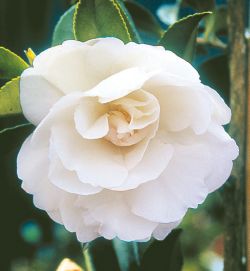
Other non-native varieties you could consider are Photinia ‘Red Robin’ or the new ‘Superhedge’, both of which have bright red new growth in spring and summer. There’s Abelia grandiflora, which has glossy bronze foliage and pale pink flowers, or for winter flowers there’s Camellia sasanqua (pictured).
How long any of these take to grow will depend on your conditions, but of the plants I’ve mentioned abelia and ‘Superhedge’ are the fastest and tōtara the slowest. With the others, allow at least five years to reach fence height (1.8m).
Start trimming almost immediately after planting to encourage bushiness. The secret of a good-looking hedge is to trim often, only taking a small amount off each time. And while the hedge is young, feed with a general fertiliser in spring and autumn and water in dry periods to encourage growth.
Weekend Gardener, Issue 165, 2005, Page 24

Advice by Andrew Maloy, former Plant Doctor of the Weekend Gardener and Kiwi Gardener magazines
Plant Doctor Archive
700 gardening Q&A’s
Source

- The views expressed here are not necessarily those of the RNZIH
- Content or advice may be out-of-date.