
|
An
Illustrated Guide to
Common Weeds
of New Zealand
Berberis
glaucocarpa
barberry
Family
BERBERIDACEAE
Reproduced
from
Common
Weeds of New Zealand
by Bruce Roy, Ian Popay, Paul Champion, Trevor James & Anis
Rahman
ISBN 0 473 09760 5
by kind permission of the
New
Zealand Plant Protection Society
Publication or other use of images or descriptive
text on these pages is unauthorised unless written permission is
obtained from the authors and publisher. Appropriate acknowledgement
of the publication Common Weeds of New Zealand must always
be given.
Available from Manaaki-Whenua
Press and Touchwood
Books
Spiny, woody,
evergreen or semi-deciduous shrub often 2-3 m tall, sometimes used
as a hedge plant. Characterised by its very sharp spines that are
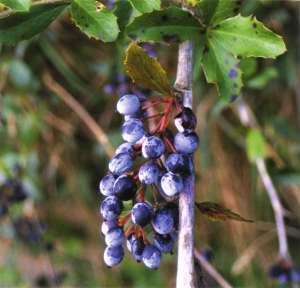
single or divided into three. Small yellow flowers followed by small
purple berries covered in a white bloom.
- Flowers
Petals and sepals yellow, flowers 5-7 mm in diameter, with an
unpleasant smell. In many-flowered drooping simple or compound
inflorescences up to 6 cm long. Flowers Oct-Nov.
- Fruit
Small, purplish, oblong berries, 7-12 mm long, with a white bloom.
Seeds are dispersed by birds.
- Leaves
Elliptical to ovate, up to 7.5 cm long by 2.5 cm wide and often
spiny-toothed.
- Stems
The main stems have yellowish-grey bark and very sharp, single
or three-pronged thorns, up to 2 cm long, in the leaf axils.
Habitat
Waste places, reverting
hill country, scrub, forest margins and former house sites.
Distribution
Locally common in
some higher rainfall lowland areas in NI and the northern half
of SI. Originally from the western Himalayas.
Comments
Planted as a hedge
in many parts of NZ, and has spread out of control in many areas,
especially on broken or hilly ground where control is difficult
and intense stock grazing (for controlling seedlings) is harder
to achieve. Barberry is subject to Pest Plant Management Strategies
in several regions of NZ. Details are available from the regional
councils or unitary authorities.
Related
species
Darwin's barberry (Berberis
darwinii) is an evergreen shrub up to 4 m tall, with attractive,
deep orange flowers in simple drooping racemes up to 7 cm long
and dark purple berries with a bluish-white bloom. The small,
shiny dark green holly-like leaves alternate in clusters of three
to five, together with five-pronged, needle-sharp spines. This
species flowers Jan-Dec, and is found in scrub, forest and plantation
margins, road-sides, being locally common in Wellington and Wairarapa
in NI and very common from central Canterbury to Southland in
SI and Stewart Island. Listed on the National
Pest Plant Accord (see Introduction for details). European
barberry (Berberis vulgaris) occurs around old homesteads
and in some plantations, in inland Canterbury and Otago. It is
a deciduous shrub up to 2 m high, losing its leaves in winter,
and with oblong, red fruits.
Derivation
of botanical name
Berberis
(from the Arabic) = barberry; glaucocarpa (Lat.) = fruit
with a bloom.

Web-notes:
Weed Links
On this site
Reproduced from Common Weeds
of New Zealand:
External Links
Weedbusters
New Zealand
- Weedbusters is a weeds awareness and education programme that aims to
protect New Zealand's environment from the increasing weed problem.
New
Zealand Plant Conservation Network Weeds Fact Sheets
- Search for 1500 weed fact sheets mainly derived from the Department of
Conservation's BIOWEB weeds database.
New
Zealand Plant Protection Society
- Their main objective: "To pool and exchange information on the biology
of weeds, invertebrate and vertebrate pests, pathogens and beneficial organisms
and methods for modifying their effects."
-
New
Zealand Landcare Trust
- Plant Pest information including Pictures, Distribution Maps, References,
Environmental Effects and Control.
-
- New
Zealand Aquatic Weeds
- Hosted by the weed management group of NIWA (National Institute of Water
and Atmospheric Research).
-
- Weed
Control Manual for the Bay of Plenty
- Weeds information compiled by Environment Bay of Plenty.
-
Massey
University Weeds Database
- A site providing information about New Zealand weeds and weed control.
It has a series of pages showing pictures of New Zealand weeds, notes on
identification and control. It also provides information on a university
paper entitled Controlling Weeds.
-
- Canterbury
Weed Guide
- A weed identification guide prepared by the Christchurch City Council.
-
- Australian
Plants as Weeds
- Part of the Association of Societies for Growing Australian Plants website.
- Department
of Agriculture Western Australia
- Collection of weed resources from the Department of Agriculture, Government
of Western Australia
- Weed
Society of Victoria
- Promoting wider awareness and interest in weeds and their management.
Includes a useful page of links
to other weed societies.
-
- Tamar
Valley Weeds Strategy
- Listing of common and botanical names, images, and information including
control methods for weeds found in Tasmania, and also on the Australian
mainland.
-
-
- New
Jersey Weed Gallery, USA
- Listing of common and botanical names and images, plus a small amount
of information for weeds that cause problems in the USA.
- Invasive
and Exotic Species of North America
- Images and other information from the University of Georgia.
- University
of California
- Weed Photo Gallery, with common and botanical names.
-
- World
of Weeds
- Weed-related resources including weed science, practical tools, gardening
tips about controlling weeds, and environmental news updates.
-
- Invasive
Species Specialist Group
- "The ISSG aims to reduce threats to natural ecosystems and the native
species they contain by increasing awareness of invasive alien species,
and of ways to prevent, control or eradicate them."
-
- Invasive
Woody Plants
- Collection of research and associated literature for invasive woody plants
in the tropics and the temperate zone.
-
- WeedScience.com
- Site that includes a comprehensive collection of weed images from around
the world.
-
-
Books
on Weeds from FetchBook.Info
More
Plant Profiles
|